Showing posts with label Naruto. Show all posts

Monday, 26 March 2012

Shounen Deaths and Their Impacts

Before I start, given the title of this post, expect that there will be spoilers ahead, BIG spoilers, for Bleach, Naruto, One Piece, and Fullmetal Alchemist.

As anyone who reads or watches a fair bit of mainstream shounen will know, the mortality rate is generally pretty damn low for the amount of carnage that goes on each chapter. Maybe the occasional bad guy will shuffle off the mortal coil once in a while, but other than that, death is a rare occurrence in this genre and for the most part, enemies just get roughed up, knocked out and generally end up bloodied but alive. So, when a mangaka does decide to kill someone off, the implications tend to be much larger and there's generally good reason behind it. Particularly, as much as I love it, one of the biggest culprits of not letting people die is One Piece, though in certain cases - namely Buggy, Crocodile and several Baroque Works members - they've returned to play an important role later on, so really it's best that they didn't head off to meet their maker after all. That being said, both Bleach and Naruto have bumped off a few baddies, but since they're enemies, you kind of don't care so much, or at least expect it (I'm still pissed that Kubo didn't kill of Aizen in the end). However, I'm not really here to discuss the killing of antagonists, my main concern in this post is that of deaths of shounen characters who, for all intents and purposes, are good guys.

Killing off your protagonists is a fairly rare occurrance in shounen and while, with all of the insane battle, it may seem a bit unrealistic, I actually believe it to be a good thing for one simple reason: it allows for any deaths to have a much larger impact on the audience. If good guys dying off were a more regular thing, then you'd get somewhat de-sensitised to it all, but when you're led in to a sense of security that no one dies and it's all hunky-dory, and THEN someone gets suddenly wiped out, it can be a devastating and emotional experience.

My first encounter of anything like this was Fullmetal Alchemist. I was happily watching away falling in love with the story and characters - in particular, my favourite of all the protagonists was Maes Hughes. So when all of a sudden he was killed off for getting too close to the central conspiracy, I was utterly devastated. I remember watching his funeral scene through a veil of tears and to this day any glimpse of his face on screen leads to a yelp of "HUUUUUUUUUUGGGGHHES!!!" Looking at it from a storytelling point of view though it was a genius move. He's a likeable guy. He's not an alchemist, he's relatively ordinary, has a family that he adores and is one of the more comical people in the tale.

To this day, Hughes' funeral remains one of the most heartwrenching scenes I've encountered in any anime series.

Having him die is an immediate and powerful way to show just how serious the situation is. Additionally, that there's no warning of his death and that it's so sudden subconsciously puts the viewer on edge, after all, anyone could be next...

More than any mainstream shounen I've encountered, there's one series that seems to be more at home with killing off protagonists (and antagonists, but I'll save that for another post), and that's Naruto. Out of the main shounen mangaka, it seems that Kishimoto is more willing to dispose of some of his protagonists in order to further the plot. He starts off with the Third Hokage, and while he's old, killing off the head of the village - and its most powerful ninja - is a bold, yet necessary step. He's not a central protagonist, so there's not too much emotional attachment, but it still goes against the general philosophy of shounen manga: that the good guys always win out. It throws Konoha into turmoil and, while not necessarily in the way he'd planned, makes part of Orochimaru's plan succeed. It isn't an instant defeat, more a partial win, but it takes away that feeling of security, that all will be OK and continue as ever, and THAT is one of Kishimoto's biggest strengths.

While the Third Hokage's is the only significant death in the first part of Naruto, Kishimoto continues to bump off some of his other protagonists in Shippuuden. In particular there are two demises that I wish to look at. The first, is that of Asuma, which has the least implications, but still remains poignant enough. That Asuma was taken out by one of Akatsuki, not only cements their position as the central antagonists of the piece, but also facilitates some maturation in Shikamaru by making him step up and graduate from being a lazy genius, to a full-fledged konoha ninja with a true "Will of Fire". Likewise, it also proves that the jounin ninja are fallible. They may be close to being the pinnacle of ninja strength (only being outshone by the kage) but they are not immortal. What they do is dangerous and they can in fact die, and it's this realisation that often makes Naruto seem more realistic than some of its shounen bretheren.

However, while the Third Hogake and Asuma's deaths held some importance in the plotline, the most significant death in Naruto by far is that of Jiraiya

Death of a Konoha legend, Jiraiya's end summed up the leaf village's "Will of Fire" to a T.

Undoubtedly he is the most central character to kick the bucket in the entire series, and it certainly has the biggest impact on Naruto himself. As the series' loveable pervert, Jiraiya's death has the biggest emotional impact on the audience. We know him more than others and like his antics, as well as respect his position as one of Konoha's Three Legendary Ninja. What makes Jiraiya's demise the most poignant however, is not the emotion but the implications it has. On a more general note, it delivers a massive blow to Konoha's firepower. Jiraiya was not only a figurehead with his position as Sannin, but he was a valuable source of intelligence with abilities that allowed him to feed important information back to the village.

But it's the repercussions his end has on those left behind that is the most striking. In particular it serves as the catalyst for Naruto's evolution. By suddenly losing his beloved master who had become like a substitute family to him, Konoha's Jinchuuriki is able to access parts of himself that had previously been locked. During Naruto's battle with Pain, he not only manages to physically power up, but he learns more about himself. On top of that, he matures incredibly as he finally understands that needless hate and desire for vengeance is nothing more than a vicious circle. He tosses aside his desire for revenge and pledges to carry on Jiraiya's will to find a road to true peace. Ultimately, that not only helps him finally defeat Nagato, but also by solidifying his ideals and essentially leaving his heart open to everyone, it lays the foundations for his later power ups and realtionships with the Tailed Beasts.

Then of course there's One Piece, a series that goes hundreds upon hundreds of chapters and episodes before killing off any of its characters. But boy, when it finally does, it does it in style. While death plays a large part in practically all of the Straw Hats' backstories, it's not really until the Whitebeard war that any active characters actually shuffle off the mortal coil and then Oda dishes up not one, but two significant deaths in short succession, both of which have a distinct, yet different impact.

First up to bite the dust is Ace, and his death has much more of an emotional impact. The audience has come to know and love him from previous encounters with him, and when he dies, it ultimately leaves the viewer at least a little upset. However, with Ace, more than anything it's the effect his demise has on Luffy that really proves the most devastating blow. Seeing Luffy break down is what truly gnaws at the hearstrings. That the usually optimistic and bubbly pirate suddenly becomes little more than a broken and hollow shell is such a powerful thing, that anyone who has become even remotely emotionally invested in the series will feel that grief resonate through them. This heartbreak not only serves as the starting point for Luffy's next big power up but it signals a change in the wind.

As much as Luffy's incessant yelling of "AAAACE!" throughout this arc got a bit much, I found myself joining in with him during this scene.

The second of Oda's double whammy of death has less emotional impact but huge political implications for the world of One Piece. Whitebeard's end was fairly incredible, but that this towering presence in the pirate community that had maintained peace for years was now gone, serves as the end of one era and the beginning of another. Nothing will be the same after this. The balance of the pirate world has been shattered and with Blackbeard stealing the Whitebeard's Devil Fruit power, the die have been cast for what will inevitably become Luffy's final battle - well, unless Oda has another card hidden up his sleeve. Since the Straw Hats' next step is to head into the infamously treacherous New World, Whitebeard's death serves to make that already deadly journey even more perilous as the heirarchical system of the pirates has been thrown into turmoil. So, when they Sunny does eventually break into this new territory, not only will they have to cope with the natural dangers, but they will also face more fearsome pirates who are now not only taking over Whitebeard's territory and throwing peaceful lands into chaos, but are also vying for the now vacant position of one of the four Pirate Emperors. This is the perfect point to draw a line and commence with what will likely be One Piece's heavier and even more epic second act.

So, while it may get rather tiresome watching everyone get beaten to a bloody pulp only to have miraculously recovered a few pages - or episodes - later, the lack of fatalities in shounen goes a long way to making the more important deaths all the more poignant, and with this week's chapter of Bleach, I am reminded of this even more. It may only be the beginning of the arc, and he may only be a minor named protagonist, but I found Kubo killing off Vice Captain Sasakibe shocking. Even though I didn't particularly care for the character, that one fatality immediately shows that Kubo means business and that this final arc in Bleach is going to be a seriously big one. It just goes to prove that the impact of having a "good" character drop off the perch at an important moment is only made that poignant, by not bumping off your protagonists at every turn, since if Kubo had been doing so for the last decade, these recent events probably wouldn't have made me even bat an eyelid.

Sometimes less is more, and this is definitely the case with deaths in shounen.

Thursday, 23 February 2012

Naruto Filler is Getting Worse

Several months ago, I wrote a post on the filler episodes in Naruto. In particular I was praising Shippuuden for at least attempting to link its filler with the story, as well as voicing concerns about the "Tales of Days Past" standalone episodes. To quote myself:

"It remains to be seen how the filler situation in Shippuuden will continue. I can, however, say with some confidence that if the crappy "comedy" episodes stick around, then any vague good that the earlier plot-relevant filler arcs did, will soon be overshadowed by the poor quality fluff currently halting the main narrative's progression."

Sadly, the above seems to have come to pass as following an all too short run of actual plot (a meager 25 episodes, of which several contained flashbacks of previous content), we were thrown back into more mundane fluff. This time, instead of recalling memories of the past, the premise for each standalone story in the twenty episode run is Naruto encountering someone or something during his painfully long sea voyage to the Lightning Country. Initially, it's bearable. OK, catching a giant swordfish is a brainless distraction but whatever, it's only one episode. Unfortunately, the "only one episode" delusion doesn't last for long, and soon you want the torture to end - JUST GET OFF THE GODDAMN BOAT ALREADY! It's Frodo shitting in the woods all over again.

Even the "comedy" elements lose their charm rapidly; there are only so many times you can see the "Oh Gai is seasick, how HI-LAAAAAR-IOUS!" gag before you wish they'd just give up and toss him overboard to see how he fares with the sharks. 

I'm somewhat behind with the anime and still attempting to trudge my way through the inane drivel that's currently gracing my screen, and with each twenty-four minutes of my life that ebbs away watching Naruto get poisoned by mushrooms, fight his own clones, or get into a battle over marriage, I feel less and less inclined to start the next installment. Frankly, the only thing keeping me going is the eventual promise of plot, and GOOD plot at that. It's a genuine shame that the fluff has descended to this level, when it was at least tolerable before - since it's now making me dread the next time that the story takes a break and I'm wedged back into this crap-padded cell known as filler. For now, I'll just have to soldier on and hold onto the tiny ray of light that is a semi-humourous moment that raises a smile and doesn't involve Gai vomiting over the side of the ship or practically dry-humping solid ground every time they dock for supplies.

Sunday, 19 February 2012

Fun With Poo

Yes, dear reader, you did read that title correctly and fair warning, this post will likely be crude. If you think that this may offend you, then please don't read, as it could get a little gross. However, this whole thing is a bit of fun (with a serious point hidden away somewhere) and well, forgive me, but this was composed at 2am when it all seemed like such a brilliant idea.

It all stemmed from a conversation I had several months ago discussing shounen manga, specifically the big three (One Piece, Naruto, and Bleach). Then at one point I came up with an analogy to highlight how the three mangaka often appear to work... through poo. I suggested that if each of the trio were told to incorporate a turd into their work it could go as follows:

One Piece (Eiichiro Oda) - I could imagine the introduction of a character that had eaten the Poo Poo Devil Fruit, which gave the user the ability to turn his entire body to poo, and shoot small (but deadly) fecal projectiles from it's hands. Upon more thought I could also imagine a running gag of this guy slipping over when in turd-form since... well... it can be slippy.

Naruto (Masashi Kishimoto) - I'd say that in a story that's generally more serious, this would likely be a little light relief, and would be a "gag jutsu", much like Naruto's Sexy Harem or the Thousand Years of Pain. The Poo-poo no Jutsu, a powerful technique that causes the unfortunate victim to develop sudden, volitile diarrhea.

Bleach (Tite Kubo) - My thoughts on what Kubo would do with a turd, was quite simple. I suggested that he would simply dress the poo in sunglasses and make it look cool.


It may seem like a throwaway idea, but in essence it displays how I see the way that the three mangakas work. Oda's One Piece has much more of a humour content than the other two, thus I can imagine that if presented with a ridiculous inclusion like this, he could use it as a starting block for something bigger, maybe a mini arc or something. Oda can take the ridiculous and make it sublimely ridiculous. Kishimoto also has that sense of fun at times, but Naruto is a much more serious story. That said, he does manage to infuse moments of levity some of which that are crude and in your face, so the inclusion of something so gross could be done without affecting the gravity of the main plotline. Finally, when it comes to Kubo, while he does have some moments of decent storytelling, it always comes across to me that he's more concerned with the style of Bleach rather than its actual content. It seems, moreso than the other two series, that it wants to look cool. It has the cool character designs, the stylised fights, and while it contains some humour, it's not on the same, almost puerile level, of the other two. So while claiming that he'd simply have a turd in sunglasses may seem like a cop-out answer (and in truth I couldn't see him ACTUALLY doing that if presented with this challenge), it symbolises more the approach I believe he'd take. Somehow, he'd find a way to make a steaming lump of faeces look cool, which when you think about it, is quite an impressive talent.

Monday, 17 October 2011

Two Years Later...

Warning: As much as I'm trying to keep them vague it's not always possible, so this post contains some spoiler information for Naruto, One Piece, Bleach, Fairy Tail, Usagi Drop, and Death Note. Each manga will have its own paragraph so if you don't want to risk finding anything out that you don't know, then please (time)skip ahead to the following section.

Last week, within the space of twenty-four hours, I encountered time skips in two different and wholly unreleated manga. Plus, with the One Piece anime having recently reached its own temporal leap, it fels like the time skip is the order of the day. Certainly, when it comes to mainstream shounen manga in particular, it seems that jumping ahead several months or years is becoming the thing to do and it's certainly an effective hook. Time skips offer up the chance to completely revitalise a manga or change its dynamic often following a climactic event, and as such prove to be a turning point wherever they feature.

Back in 2005, Naruto started the recent trend with the two-year leap following the events of the Sasuke Retrieval Arc. Having come to a definite conclusion it offered up the perfect chance to power-up the protagonists with each member of Team Seven walking their own paths to train. Sasuke turned his back on Konoha in order to get into the metaphorical bed with Orochimaru, Sakura - fed up of being the useless one - begins her tutelage as a medical ninja under Tsunade and Naruto heads off on his journey with Jiraiya to become stronger than ever. The skip also marks a distinct change in focus. Whereas Orochimaru plays the role of lead antagonist in the first part, the two-year jump marks the switch to when the biggest thread to the ninja world is actually Akatsuki.

In the same year, another Shounen Jump hit also hopped on the time skip bandwagon. Death Note however opted for a six year differenceto mark the beginning of a new saga. With the manga focusing on the game of cat and mouse between L and Light, L's death comes as a climactic event that in no uncertain terms ends what the whole story has been about. The mangaka then take the opportunity to skip ahead to allow the next generation to come to light. Had Near (also known as L-clone) appeared immediately after his predecessor's demise, then all the spiel about how L was the only one capable of katching Kira would have been flushed down the toilet. Likewise, it allows for Light to become more even more confident and complacent. In not being an excuse for the protagonists to simply power up, Death Note's time skip shakes up the pace by similtaneously starting from the very beginning (L-clone's investigation) and continuing the second act (Kira/Light's reign of terror).

While the leap in Death Note proves interesting in it's own way, the "powering up" time skips are what it's all about for me and both the ones in Naruto and One Piece work in essentially the same way. In both series the main characters split off (though this happens forcibly in One Piece) and undergo their own training following a distinct loss (Sasuke's departure from Konoha and the events of the battle at Marineford). By the time that the characters return from their adventures, there's a definite sense of excitement and anticipation. What will they look like now they're two years older? What new moves will they have? How much stronger are they? If done well, the events immediately after a time skip can keep you on the edge of your seat. One of the best examples of this is One Piece where Eiichiro Oda has not only timed the timeskip perfectly but also plays out the beginning of its second act with pacing so spot on that it keeps you hooked.

The two-year leap in One Piece came at the ideal time. The Straw Hats had made it half way along the Grand Line and were about to enter the New World, a sea so full of peril that it supposedly makes their adventures thus far seem like playtime. Additionally, following the Whitebeard War, a distinct singular villain has emerged, which all means that the dynamic of the plotline could shift. As for the anticipation value following the skip, that Eiichiro Oda had split up the Straw Hats some considerable time before, he now hits us with a double whammy of excitement: the gang finally reuniting plus the results of their training. Also throughout the course of the fishman island arc, Oda has only gradually revealed just how powerful the crew have become and with each teensy glimpse of Usopp's toned awesomeness or Zoro's even more deadly slashes you can't help but marvel. While Naruto brought out most of the hero's new awesomeness in one Orochimaru-targetted attack in the arc following the skip, One Piece spreads it out creating several smaller awe-inspiring moments as opposed to that one jaw-droppingly epic scene.

It was only last year that One Piece skipped ahead, but hot on its heels was Bleach with it's very own leap. Unfortunately, while placed after a climactic battle and Ichigo's subsequent power loss, this time skip is the most underwhelming of the big three by quite some margin. While it has allowed eighteen months for Orihime, Chad, and Ishida to power up, this becomes slightly meaningless as Bleach always has (and seems that it always will) focus on Ichigo's ridiculously strong abilities and the constant power-ups that Kubo seems to yank out of his arse every so often. Instead, it seems that the main funtion of this skip is to make it so that Ichigo doesn't lose his powers only to suddenly regain them immediately after. It also doesn't help that the end of the arrancar saga had a very definite conclusion and the manga felt like it could have ended right there and then and everyone could go home relatively happily. So whereas the likes of Naruto and Death Note promise more and feel unfinished, making their skips more exicting, Bleach's seems to lack purpose by comparison, other than to drag out a series that probably should have been laid to rest with Ichigo's shinigami abilities.

The most recent time skip in a shounen manga - only a couple of weeks ago - is that of Fairy Tail which, following a pretty horrific event that devastates the main cast, jumps ahead seven years. Now with such an epic skip, you would be expecting something great, unfortunately I'm yet to be convinced that this was a sensible move for Mashima. With the Edolas arc and the following Tenrou Island plotline, Mashima had really found his stride and various plotlines were all weaving together. Now, with the timeskip, he's lost all that momentum and frankly, with the latest installment (chapter 255) I'm getting concerned as to how this will all turn out. This week's chapter felt rushed. Everything happens at one hundred miles an hour to the point where it feels like Mashima just wants to get this little bit of explanation out of the way and done with. At the moment it doesn't fill me with hope, but I won't write it off just yet as this is a bit of a timeskip with a difference, and the dynamic between the drastically altered and the unchanging could prove interesting.

Of course time skips aren't just limited to shounen, and one in particular that I'd like to mention is the one in Usagi Drop. This series is a perfect example of how a time skip can completely change a story. The first four volumes of Usagi Drop place strict focus on Daikichi learning how to take care of Rin. It's about his growth as an adult, his development as a parent and the dynamic between an awkward single thirty-year-old and an innocent six-year-old girl. Then suddenly, at the beginning of volume five, everything changes. Without really reaching a definitive moment beforehand, the manga jumps ahead ten years. Now, instead of being a story about a man coming to terms with sudden parenthood, the focus shifts to become more about the romantic entanglements of a teenage Rin. Now a decade-long skip would be pretty epic in most places, but in a story centring on a child it changes it 100%. Imagine if Yotsuba&! did that? Instead of being a manga about a naive and exciteable girl exploring the world, it became a tale about a hormonal teenager trying to date the school hottie. It seems wrong, right? Certainly, I enjoyed the Usagi Drop manga much less after the time skip, since it wasn't the story I'd fallen in love with - that and I still can't help but feel that the final direction it went in was just plain wrong.

Time skips can be the making or breaking of a manga and it all depends on several factors:
  • Is the time skip necessary/does it come at the right time.
  • How the mangaka handles events following the timeskip.
  • Personal preference.
While points one and two are integral, for me it's the third one that will ultimately decide whether the skip has been successful or not. I have not been enamoured with the jump in Bleach but I don't doubt that there are people out there who love it as much as I love the skips in One Piece and Naruto. Similarly, because I personally dislike the direction Usagi Drop takes after the jump, I find myself disappointed by the manga. What I'm going to find most interesting however is seeing how the Fairy Tail skip pans out since I have yet to grasp whether it's awesome or awful and at the moment my stance changes from week to week. But despite everything, I still love a good time skip, as even if there have been times where I've been disappointed, sometimes it's good to shake things up a bit.

Saturday, 8 October 2011

An Ode to Oda

Disclaimer: This post contains spoilers for both the One Piece anime and manga.

It should come as no surprise to anyone who has seen me around the internet, that I have an unending adoration for One Piece. In truth I was somewhat late to the Straw Hat party, only starting the anime at the beginning of 2009 - nearly ten years into the anime's run and a good THIRTEEN after the manga originally started. Having denied myself the pleasure of Luffy and the crew for several years beforehand due to the crazy episode count, I finally gave in and ended up marathoning all that was available in the space of about two or three months. Night after night I immersed myself in the world of the Grand Line, laughing, cheering and crying my eyes out along the way. And when I ran out of episodes, I devoured the movies, specials and ultimately the manga. But why is it that I love this franchise so much, or more importantly, why have I continued to love it so much even two and a half years later? If I were to pin it down to one specific reason it would be this: Eiichiro Oda knows what he's doing.

It may sound like a fairly obvious observation given that he's a professional mangaka with a highly successful and long-running series in Shounen Jump, but being successful and knowing exactly what you're doing don't necessarily go hand in hand. Looking at how the story is progressing, it's clear to see that Oda has a solid idea of where he's heading. He knows in which direction he wants to go and sets his plans in motion early on, scattering odd parts through the crew's early adventures that will become useful as time goes on. For example, the Little Garden plotline may have seemed like a fluffy or almost throwaway arc used only to showcase the extremes of the Grand Line. However, the crew's encounter with the two giants, Dorry and Broggy, becomes essential in the later Enies Lobby arc and greatly contributes to their success. Had they continued their massacre of the show, quite how the infamous 4-Kids dub would have explained those events away after cutting the entire Little Garden arc, I do not know.

This definite sense of direction does Oda much credit, especially since this isn't a trait that seems to be shared by all of his peers. Oda's careful planning is in stark contrast to Tite Kubo, whose manga, Bleach, completely lacks that sense of purpose. Before the end of the arrancar saga, there appeared to be some idea of where it was all going, but considering that the Hueco Mundo arc felt like little more than a rehash of the Soul Society plotline with added arrancar, it still felt a bit haphazard. Likewise, Kubo has openly admitted that when he runs out of ideas, he adds a new character. Again this goes against Oda's style of work, where he adds characters when the story requires it and fully fleshes them out instead of tossing them aside when their shock value or interest factor has worn off. As such, One Piece proudly boasts one of the fullest casts of any shounen series and that characterisation ability makes the already impressive narrative all the more so.

Aside from the sense of direction that Oda's work exudes, the veteran mangaka knows how to construct a story and make it appeal to the masses. For each individual arc he gives enough background information to fully set the scene, which helps to make the following battles all the more epic and shocking. Meanwhile he withholds key information to be revealed at a later moment for maximum shock value. For me, this is most deftly demonstrated in the Water 7/Enies Lobby saga (there WILL be massive spoilers from this point on, so if you haven't seen/read this arc please skip the next paragraph).

Without a doubt, Water 7 and Enies Lobby is, in my mind, when One Piece gets truly epic and that's entirely down to Oda's ability to plan out his story and visualise every aspect of this world. He starts by introducing you to the island of Water 7, an impressive city built on two levels and completely at the mercy of the weather. He introduces you to the Galley-La company of shipwrights and begins on one of saga's mini-arcs - that of the Going Merry's fate. Oda makes you engage with the new characters and helps to immerse you in the culture of the island, and then it all goes tits up. Oda then proceeds to throw multiple challenges in the faces of the Straw Hats to really test them. The loss of Usopp, the approaching, devastating storm, the emergence of a special government assassin group known as CP9 attempting to kill Iceburg and seemingly "recruiting" Robin, and the Straw Hats getting blamed for the attempt on Iceburg's life. Then with the knowledge that Robin in fact hasn't betrayed them, but is sacrificing herself for the safety of her crewmates, the stage is fully set for the epic fighting on Enies Lobby as Luffy et al take on the World Government itself. But even when the battle section of the saga commences, Oda still has the odd trick up his sleeve, rewarding the audience by finally revealing Robin's past, giving the cowardly Usopp some balls as the confident Sogeking, and making links with the previous Little Garden arc thus proving that their past actions have meaning and can affect their future. By doing this and still creating some of the most heart-stopping battles of the manga (the Luffy vs Lucci fight is pretty damn awesome), Oda makes his story wholly engaging. I remember when I watched this saga, I cried buckets at Luffy and Usopp's fight, felt heartbroken at Kaku's betrayal, sat on the edge of my seat at the crew battled CP-9 and laughed my arse off at Franky's "recruitment" into the Straw Hats. I couldn't wait for the next episode and watched one after the other, annoyed that I had to sleep because it meant I couldn't continue watching. And when I got to this story in the manga, I was just as excited if not moreso.

What also really makes the Water 7/Enies Lobby saga is the characterisation, another aspect where Oda excels. The mangaka fully explores his cast with each of the central players having their own pasts. Admittedly backstory isn't a new thing in shounen manga, but what Oda does that not so many others do, is he focuses on the crew's growth equally. Each character goes through their own journey and they're just as important as Luffy's since while the young captain will still be the saviour of the day, the story isn't all about him. While Bleach tends to leave its supporting mains slightly more in the background while focusing on the main hero, One Piece and to a slightly lesser extent, Naruto, plays out more as an ensemble show. In Bleach, the likes of Orihime, Chad and Ishida hide in the shadows and return powered up. Naruto fares much better, with Kishimoto showing the likes of Sakura's determination to not be left behind, Lee's incessant drive to become powerful despite his complete lack of ninjutsu skills, and Shikamaru's transition from lazy genius boy to a dependable and invaluble strategist. However, only in One Piece is the balance of power more evenly spread. While the Konoha ninjas may be strong in their own right, they still have a habit of relying on Naruto to save the day. In contrast, while some of the "weaker" Straw Hats have a tendancy to rely on others to help them, it's not purely Luffy they depend on, it's also Zoro, Sanji, Robin, Franky and Brook. But even then, each and every member of the crew is intent on becoming stronger so they can support Luffy (this is possibly also due to their own desires to achieve their dreams) as opposed to simply hoping that he'll save the day. That Oda allows more than one single hero to shine in the spotlight makes the story all the more interesting as there are infinite opportunities for growth.

As you can probably tell by now, Eiichiro Oda is the one of the mangaka I most admire. His vivid imagination allows him to create fully fleshed out and epic stories that will make you laugh, cry and cheer and you watch or read your way through them. He has managed to keep up the quality for well over a decade now, and as teh story progresses it just keeps getting better and better. Certainly the new Fishman Island arc complete with powered-up Straw Hats has me craving each new chapter, and I cannot wait to learn more about their two-years training and just what Oda has in store for us in the New World.

Friday, 16 September 2011

Naruto: Overrated or Undersold?

As probably one of the most widely known anime series to westerners, it's likely that every anime fan will have some kind of opinion on Naruto, whether they've ever seen it or not. My current musing on this phenomenon of a franchise is whether the series is overrated and not at all worth the hype or if in fact, it's undersold and it's true brilliance hidden. I have come to the conclusion that in truth it's actually a mix of the two.

What draws me to this way of thinking is the series' overwhelming popularity and the phenomenon known as the "Narutard". While popularity is generally considered a good thing (particularly in western countries that naturally don't get the wide variety of shows/merchandise) when a certain fandom gets repeatedly shoved in your face like a clown who just discovered the custard pie and doesn't know when to quit, it does more harm than good. Undoubtedly this is the case with Naruto, whose gleaming success and rabid fanbase have had two significantly negative, yet utterly contrasting effects.

First off the hype surrounding Naruto has a habit of massively overselling it. With so many people raving that it's the most awesome series ever to grace our screens, it's unlikely that any show, let alone this one, will ever manage to live up to the expectations planted in your minds. I personally love the series, and have done ever since four years ago when I marathoned through series one and the first thirty odd episodes of Shippuuden. However, even I have to admit that the anime is overrated in comparison to the impression many of the hardcore fans will give you. That being said, the manga with it's tighter pacing and concentrated plotline unhindered by filler does live up to the hype, though still not up to the Narutard levels of being the greatest story ever told.

On the other side of things, the show's popularity serves to massively undersell the story's worth. With the fandom being hurled at you every which way it can likely have the effect of making one boycott it on pure principal. When confronted with legions of people in Konoha cosplay or Akatsuki cloaks at any anime-related event and Narutards running around adding "no jutsu" and "dattebayo" to the end of everything they say, many will find their view of the franchise tainted so that they either dislike it when they do watch or immediately hate it without even giving it a chance. Sadly, to those who haven't seen or read the series, or those whose views have been tainted, one of the first things they'll think about when they hear the word "Naruto" is not the well-constructed plot, the engaging battles or the impressive characterisation, but instead the crazed fans who make you ashamed to watch the show in case someone mistakes a simple fan for a complete Narutard.

As to whether individuals consider this behemoth franchise as being overrated or undersold, well that inevitably comes down to your own experiences and mindset. Personally, I think that the negative reaction to the publicity and adultation the show receives from both the industry and fans alike overshadows what is actually a genuinely good story. Sure, the anime isn't the amazing masterpiece that some make it out to be, and I certainly worry about those who claim that "Naruto is their life", but I feel that there's been so much prejudice surrounding the fandom that those new to it don't always give it a fair chance. I've experienced this with my best friend, who eventually picked up the series after my insistence that "he'd love it". He went into it on the back of irritation with the hype, never really gave it a proper try and dropped it after eight episodes focusing on small details to the point where they became genuine hatred. A couple of years - and many "Naruto sucks!" comments - later, myself and another friend convinced him to read the manga. He then powered through to the timeskip where he has now picked up the Shippuuden anime and is really getting into it (well excluding the filler that is) and finding the main plotline genuinely impressive.

My advice to anyone out there considering picking up either the anime or manga is this: try to forget everything you think you know about Naruto. Ignore the fans that froth at the mouth with the site of every kunai and forehead protector. Ignore the people who claim it sucks without giving any justification. Don't expect a masterpiece, and don't expect a steaming pile of crap. Instead, go into it with an open mind. If you do, then you may be surprised.

Wednesday, 7 September 2011

Shounen Filler: Naruto

Having already looked at how Bleach uses and abuses filler, I thought I'd continue my series on shounen series and their love of padding out the narrative by taking a look at another of the big three: Naruto. Having been split into two separate series (Naruto and Shippuuden) both parts of the franchise treat their anime-only episodes differently, so I will look at them individually.

Naruto:

Ah the original series documenting Naruto's escapades before the two year timeskip. Predominantly, Naruto uses short filler arcs lasting up to a maximum of five episodes as well as the odd standalone comedy episode (for example the episode where Naruto tries to see what lies beneath Kakashi's mask). However, what this series is infamous for is lumping over 90% of its anime-only content together in one solid 85-episode run after the Sasuke Retrieval arc. This series essentially does the same thing that Bleach is currently doing and simply delays the timeskip by showing Naruto on a series of short missions before he heads off on his training with Jiraiya.

The one good thing about this approach is that, in bunching the filler together in one solid block, it's very easy to skip. As soon as the main action finishes and you see Naruto getting sent off on some mundane assignment, you can happily run for your (curry of) life and move straight on to Shippuuden should you so desire. However, as easy as that may be, it doesn't change the fact that for the best part of TWO YEARS, Naruto pissed off its fanbase with bland filler, something that even Bleach with it's long-ass anime-only plotlines hasn't attempted - yet.

Naruto Shippuuden:

Unlike its predecessor, Naruto Shippuuden, treats filler in a manner more akin to Bleach in that it tends to err more towards longer filler arcs - though each one averages out at a little over half the length of the latter's. To Shippuuden's credit, while each arc individually annoys the viewer by interrupting the awesome plotline (seriously, well done Kishimoto on a jaw-dropping narrative), the anime-only content at least works around the central story. Instead of just coming up with some lame plotline set in the Tea Country or whatever, Shippuuden offers up a semi-lame story depicting a narrative-relevant sidestory - such as showing the capture of the "Three Tails". While this still can't fully excuse the padding, it's nice that they actually attempt to do something more meaningful with their extra content and the result isn't completely horrific.

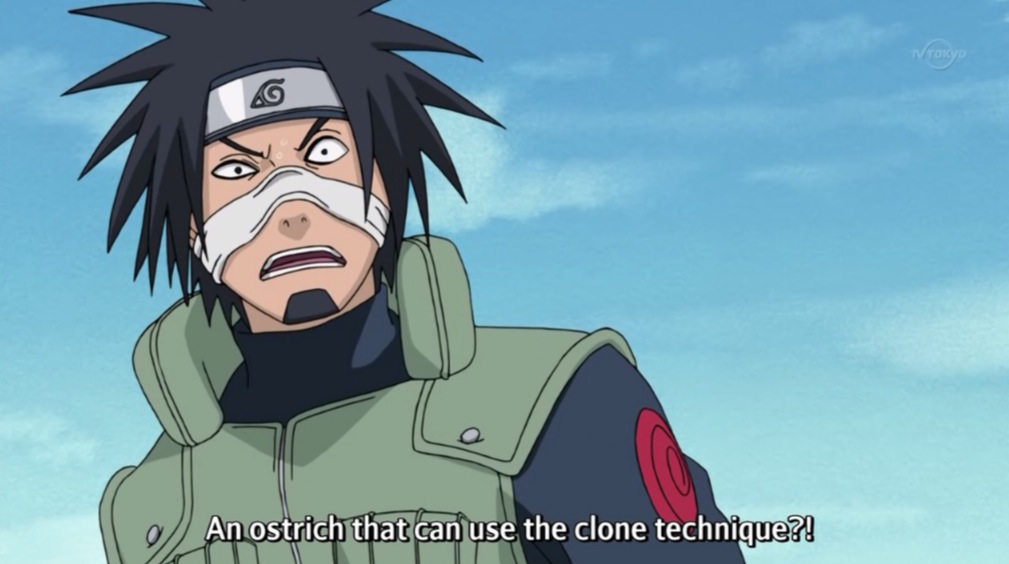
All this being said, the most recent block of filler (the one after the cumulation of the Pain arc) has deviated somewhat from this and has become more a collection of standalone episodes depicting the "Tales of Days Past". This is sadly where the quality really plummets down the toilet. While some of the episodes - such as those showing Iruka's past and Kakashi becoming the leader of Team 7 actually prove quite interesting, it doesn't take long for the "comedy" episodes to rear their ugly, deformed heads. With gems such as Naruto chasing around a ninja ostrich and Sasuke fighting a giant cat to complete his "paw encyclopedia", it's a wonder that the viewer doesn't end up completely comatose after five minutes.

Yeah, I think we were all about as impressed with that as you were, Kotetsu.

It remains to be seen how the filler situation in Shippuuden will continue. I can, however, say with some confidence that if the crappy "comedy" episodes stick around, then any vague good that the earlier plot-relevant filler arcs did, will soon be overshadowed by the poor quality fluff currently halting the main narrative's progression.

Uhh... Thanks Gai, but you can keep them. And take the fluffy filler with you.